Transportation Minister George Santoro presented on Tuesday, June 9, an overview of ongoing railway projects in the country, detailing prospects for new auctions and planned investments for the coming years.
During his participation in the program Bom Dia, Ministro, Santoro highlighted that the Federal Government’s actions have been decisive in recovering the role of ferrovias in Brazil’s logistics matrix. According to him, the resumption of stalled works and increased infrastructure investments contribute to strengthening confidence in the country and reducing transportation costs.
“When the president takes over the government, we resume works that had been stopped for years, old dreams of Brazilians. Today, people have returned to dreaming of a great Brazil, a Brazil that has efficient logistics, where cargo cannot cost more to transport from Mato Grosso to Santos than from Santos to Shanghai. We need to end this”, he stated.
Among the main initiatives planned for the sector is the holding of eight railway auctions throughout 2026. The projects encompass stretches located in the states of Rio de Janeiro, Espírito Santo, Minas Gerais, São Paulo, Bahia, Mato Grosso, Ceará, and Pernambuco.
The concessions are part of the federal strategy to expand the participation of railway transportation in cargo movement. Currently, the mode accounts for 17.7% of national logistics, a percentage that the Federal Government intends to raise to 34.6% by 2035, according to targets established by the National Logistics Plan (PNL 2035).
The expectation is that the projects will mobilize approximately R$ 600 billion in investments over the coming years, combining public and private resources to expand and modernize the Brazilian railway network.
“We created the first public policy for railway concessions in Brazil’s history. We improved regulation. We acknowledged that the private sector alone is not capable of managing a railway portfolio. Railway portfolios worldwide were developed with government involvement. There is no ferrovia in the world where the government did not participate”, the minister declared.
Intelligent Railways Model
Santoro also highlighted the advancement of the so-called “intelligent ferrovias” model, a strategy that seeks to accelerate the implementation of new projects through the simplification of bureaucratic steps and the prior recovery of railway assets.
In this format, the public sector directly participates in restructuring existing infrastructure, reducing the time needed to prepare projects and making them more attractive to private enterprise.
According to the minister, while a conventional concession process can take between three and four years to structure, the new model allows this stage to be completed in approximately one year.
“The government, in partnership, invests money in the project to recover Brazilian railway assets. In other words, we will invest money for whoever enters the auction and wins it to recover the stretch. We do this in a simplified manner. If I were to follow a traditional concession process, it would take three or four years. With this model, we managed to complete the project in one year”, he explained.
To enable the initiative, the Transportation Ministry conducted a survey that identified approximately 25,000 kilometers of unused track throughout the country. Based on this mapping, portfolios of assets were structured for future auctions.
“We mapped these 25,000 kilometers of unused track in the country and developed several projects. We are releasing these portfolios. If this auction succeeds, we will release other projects on smaller stretches. We took stretches that are currently unused and brought in private enterprise”, he stated.
Transnordestina Advances
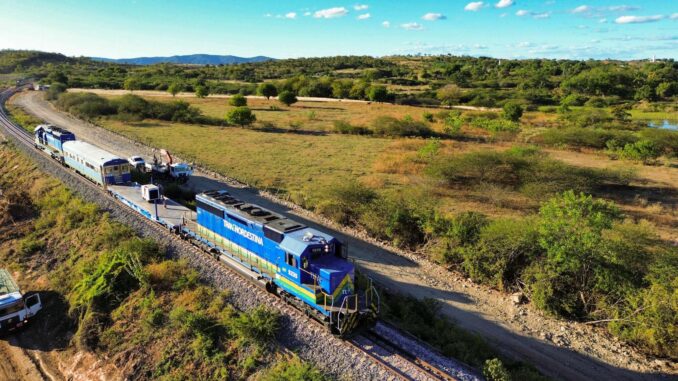
Another highlight presented by Santoro was the progress of works on the Ferrovia Transnordestina, considered one of the country’s main logistics initiatives.
The project will connect the interior of the Northeast to the ports of Pecém, in Ceará, and Suape, in Pernambuco, in addition to serving areas of the Piauí cerrado.
According to the minister, federal investments allocated to the work have been accelerating the pace of execution. This week, construction reached a significant milestone with the installation of 1,700 meters of track in a single day. The forecast is that more than 200 kilometers of permanent way will be installed throughout 2026.
“In a country that went eight years without laying almost any meter of track, laying more than 200 kilometers of new track on this ferrovia is an important historical record for developing the Northeast”, he highlighted.
New Credit Line for the Sector
To expand the investment capacity of concessionaires and stimulate new projects, the National Bank for Economic and Social Development (BNDES) is preparing a specific financing line focused on the railway sector.
According to Santoro, the modality will feature differentiated conditions, including longer payment terms, which could increase the attractiveness of projects to national and international investors.
“The BNDES will announce a specific financing line for ferrovias. We are dealing with a very special financing line, with ample time to pay, and this will attract new investors from Europe and Chinese investors to enter railway projects in Brazil”, the minister concluded.
Be the first to comment