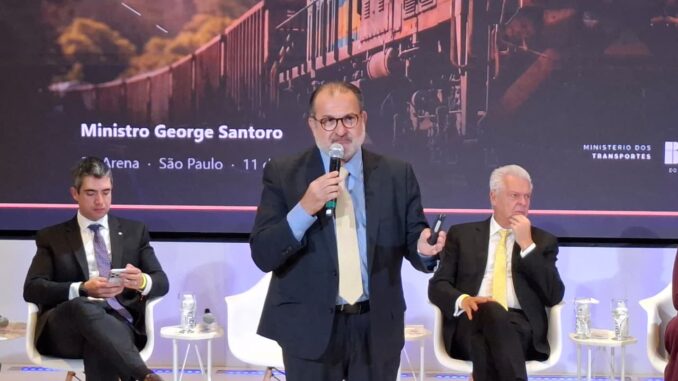
The National Bank for Economic and Social Development (BNDES) announced on Thursday, the 12th, a new financing line aimed at the railway sector, extending to up to 40 years the repayment period for resources allocated to transport projects and railway infrastructure, specifically targeting cargo operations. The launch took place during the event New Paths on Rails: The Future of Ferrovias in Brazil, held at Arena B3 in São Paulo, with the presence of the Minister of Transportation, George Santoro.
The initiative represents a significant shift in the sector’s financing policy. Currently, the bank’s loans typically have terms of between 20 and 25 years. With the new modality, the period nearly doubles, better aligning with the profile of railway investments, characterized by high capital volumes and long maturation cycles.
According to Felipe Borim, superintendent of Infrastructure at BNDES, the measure seeks to expand the leverage capacity of projects and improve their economic viability conditions.
“We are announcing a new credit line for ferrovias, extending the financing term, which normally falls between 20 and 25 years, to up to 40 years. It is a specific initiative for the railway sector and aligned with the needs of this type of investment”, he stated.
In addition to the extension of the repayment period, the new line will feature more flexible grace period mechanisms, adjusted to the timeline of construction execution. The model also incorporates tools already used in highway concessions, such as flexible guarantees and customizable amortization systems, allowing for a financial structure more suited to the reality of each undertaking.
“With this, we allow a greater level of leverage, which helps make investments viable. We will also have grace period mechanisms appropriate to the implementation timeline of projects and financial instruments that have already been successfully applied in other infrastructure segments”, Borim added.
The measure reflects a more aligned understanding of the particularities of the railway mode. Unlike highway concessions, which begin generating revenue a few months after the auction through toll collection, railway projects require years of construction before they begin commercial operations.
In commenting on the new financing policy, Minister George Santoro highlighted precisely this structural difference between the two modes.
“When it comes to ferrovias, especially in greenfield projects, it is necessary to make large investments before any revenue is generated. While a highway can begin collecting tolls a few months after the auction, a ferrovia may take eight years or more to enter operation and produce cash flow. It is necessary to create mechanisms that cover this viability interval”, he explained.
Concession Portfolio Totals R$ 160 Billion
During the event, the Ministry of Transportation also presented its railway concession portfolio, which calls for nine auctions through March 2027. The package includes eight already-structured projects at different preparation stages, with the potential to generate approximately R$ 160 billion in investments in the national railway network.
In parallel, the Federal Government is working with an even broader perspective for the sector, estimating approximately R$ 600 billion in investments distributed across strategic projects such as Malha Oeste, the Minas-Rio Corridor, the three corridors of Malha Sul, the Southeast Railway Ring, EF-118, the FICO/FIOL integration, and Ferrogrão.
The strategy seeks to prepare the country’s logistics infrastructure for the expected growth in industrial, agricultural, and biofuel production in the coming years. The objective is to expand integration between existing railway networks, connect regions still without railway access, and strengthen complementarity between ferrovias, highways, and ports, reducing logistics bottlenecks in export corridors, especially at Porto de Santos.
For Santoro, the project portfolio has reached a level of maturity that allows for the advancement of auctions already in the second half of this year.
“Today the portfolio is much more mature than it was a year ago. We have four projects under review at the Court of Accounts of the Union and others in the referral stage. Everything is advancing so we can conduct an important sequence of auctions in the second semester,” he stated.
Among the priority undertakings is Ferrogrão, whose bid notice should be sent to the Court of Accounts of the Union (TCU) still this month of June. The government’s expectation is to conduct the railway auction still in the second semester.
Despite the expansion potential, Brazil still faces a historical challenge in railway infrastructure. Currently, the country has fewer than 10 thousand kilometers of effectively operational ferrovias, a number significantly lower than the approximately 35 thousand kilometers of railway network that existed throughout its history. The expansion of financing mechanisms and the resumption of investments are viewed by the government as fundamental steps to reverse this scenario and expand the participation of ferrovias in the national logistics matrix.
Be the first to comment