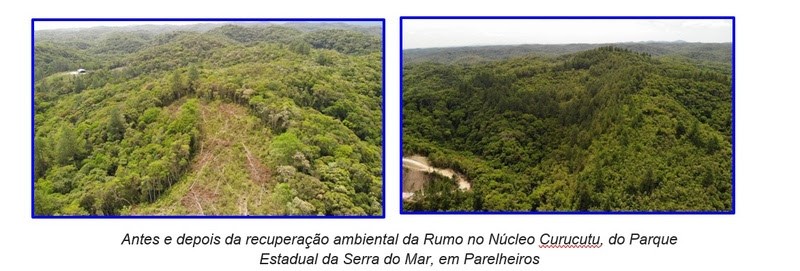
Rumo completed another phase of environmental recovery of 48.6 hectares of Atlantic Forest and Cerrado along Malha Paulista, an area equivalent to approximately 68 soccer fields. The work involved the recovery of degraded areas through the planting of native seedlings and the removal of over 2.8 thousand invasive exotic trees, species that compete with local vegetation and hinder natural regeneration processes.
The interventions were carried out at Núcleo Curucutu, in Serra do Mar State Park, in Parelheiros; at Itirapina Ecological Station; and in the Evangelista de Souza region, in the southern zone of São Paulo capital, located around Serra do Mar State Park. The three areas contain important remnants of Atlantic Forest and Cerrado.
According to the company, species such as Pine and Eucalyptus alter the natural characteristics of environments, compromising biodiversity. In addition to hindering the regeneration of native vegetation, these trees reduce the diversity of local flora and contribute to the degradation of habitats used by wildlife.
“These areas play an essential role in preserving São Paulo’s biodiversity. Environmental recovery strengthens the natural processes of native vegetation regeneration, contributing to ecosystem recovery and the creation of more balanced environments for fauna and flora. This work generates significant benefits, expanding biological diversity and promoting improved environmental quality,” stated Paula Durante Tagliari, executive manager of Environment at Rumo.
In addition to management actions, the company implemented an environmental compensation project in an area of 9.47 hectares of Ipanema National Forest (Flona), in Iperó (SP). The initiative included the planting of 10 thousand native seedlings and the use of a technique known as muvuca, which consists of applying a mixture of seeds to stimulate vegetation regeneration and expand plant diversity.
The actions are part of a broader company strategy aimed at biodiversity conservation along its ferrovia network. In addition to ecological restoration projects, the company maintains permanent wildlife monitoring and protection programs, ecological corridor management, and implementation of structures designed to facilitate safe wildlife crossing.
Currently, Rumo has 1,895 mapped structures that can be used by wildlife to cross areas near the ferrovia more safely. The company also has 10 wildlife overpasses implemented and 54 kilometers of directional fencing aimed at reducing wildlife-vehicle collisions and strengthening connectivity between habitats.
Monitoring of recovered areas
Following the completion of interventions, the areas began receiving periodic technical monitoring to track the evolution of natural vegetation regeneration. The company also evaluates the continuity of partnerships with conservation units for the development of new voluntary environmental conservation actions.
“Environmental regeneration is a continuous process. Our work now is to monitor the evolution of these areas to ensure that the Atlantic Forest and Cerrado recover their natural characteristics and continue to provide suitable conditions for native fauna and flora,” concluded Paula Tagliari.
Be the first to comment