By Ana Caroline de Faria Eduardo Borges, Administrative and Financial Director of CPTM
Speaking about women’s performance in the railway system, where male presence is still predominant, is the first step toward transforming realities, breaking paradigms, and opening pathways for us women. As financial director of CPTM, my daily mission involves closely examining management efficiency, contracts, and the company’s financial solidity. However, I am convinced that sustainable and innovative companies are not built on numbers alone, but on prepared and diverse people. For this reason, shifting the needle on inclusion and creating opportunities for more women to occupy their spaces in the sector is also a central commitment of my journey.
In assuming this leadership position, I understood that my trajectory represented not only an individual achievement, but also the opportunity to open pathways, expand perspectives, and strengthen the presence of other women in strategic spaces within the company.
And we have advanced consistently. Today, CPTM already has more than 1,160 female employees, representing approximately 19% of the workforce and working in more than 500 operational positions. However, in a modal where more than 50% of passengers are women, female participation in operations, maintenance, and leadership should be even greater. After all, complex transportation systems require diverse teams capable of anticipating challenges and designing solutions that reflect the real society we serve daily.
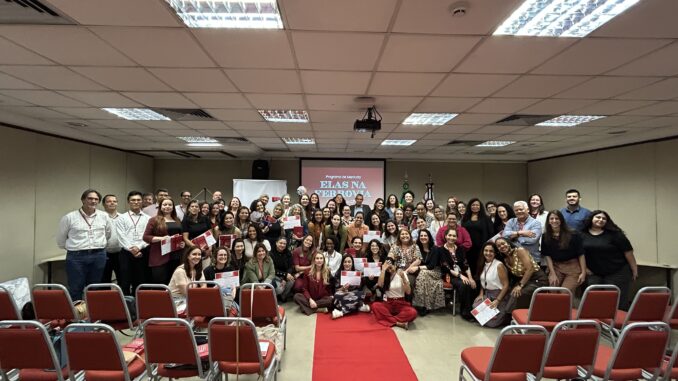
It was precisely by looking at this need that the Elas na Ferrovia program was born. Developed and implemented in 2024, the program emerged with the purpose of strengthening competencies, developing talents, and expanding female leadership within CPTM. Throughout this journey, Elas na Ferrovia has consolidated itself as a movement of cultural transformation, connection, and development—something that happens when there is a clear, genuine purpose capable of mobilizing people.
In the first edition, 38 employees participated in the initiative. In the second, we expanded to 84 professionals. Now, in June, we will open 200 positions for the third edition, consolidating an initiative that grows in a structured and increasingly relevant manner for the company.
The new edition also incorporates exclusive training in Artificial Intelligence tools, preparing our employees for the challenges of increasingly technological, connected, and data-driven mobility. Because investing in the development of women in the railway is, fundamentally, investing in the future of urban mobility.
And the results reflect this very clearly. Currently, the program registers 95% overall satisfaction among participants, plus 88% positive perception regarding career vision, skill development, and personal and emotional growth. These are important indicators, but for me, the most significant is perceiving the strengthening of self-confidence, leadership, and sense of belonging among these women in the company.
The impacts of Elas na Ferrovia have begun to surpass the company’s boundaries, with notable media coverage, reinforcing CPTM’s positioning as a company committed to human development, innovation, and cultural transformation. Beyond demonstrating that the company is at the forefront by making diversity, inclusion, and female leadership in urban mobility an action.
But perhaps one of the most relevant results emerged spontaneously within CPTM itself. From Elas na Ferrovia, we began to perceive a genuine movement of connection, support, and sisterhood among employees. New meetings, affinity groups, and initiatives aimed at strengthening women naturally began to emerge within the company, such as the ‘Mulheres que Movem’ event, which featured a panel with women in leadership positions at CPTM and guests from other companies.
This cultural change generates a multiplier effect that extends beyond our stations. When a woman operates a train, manages maintenance, or leads complex budgetary decisions, she becomes a mirror. She shows the next generations that that place also belongs to them. Because when women find real opportunities for growth and recognition, they also begin to drive other women forward. They create support networks, strengthen one another, and contribute to more humane, collaborative, and transformative environments.
Seeing these results happen is what motivates me to move forward. We know we still have many challenges ahead in a historically male sector. Breaking cultural and structural barriers requires consistency, courage, and continuity. After all, it is not enough to simply open doors; we must ensure permanence, welcome, and real opportunities for growth.
For this reason, I invite you to follow me on this journey. May we, together, discuss how sisterhood and mutual influence can accelerate our growth, consolidating once and for all the female presence on the rails of the future.
Be the first to comment