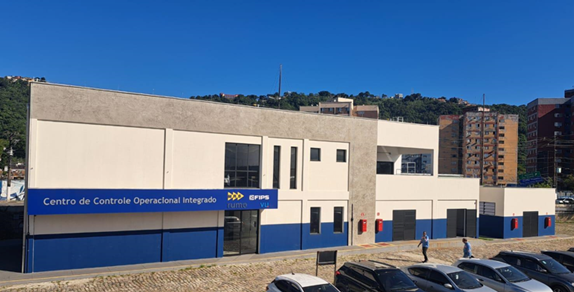
The freight ferrovias operating at the access to Porto de Santos inaugurated the Integrated Operational Control Center (CCOI) of Baixada Santista. The delivery of the CCOI marks the completion of an investment cycle of R$ 2 billion carried out by MRS in the region, aimed at intermodal integration and expansion of ferrovia capacity accessing Porto de Santos, the largest port in Latin America.
The new CCOI brings together, in a unified operational planning environment, MRS, Rumo, VLI and the Ferrovia Interna do Porto de Santos (FIPS), replacing the model of independent control centers for each operator. According to the companies, integration will allow optimization of communication, organization of ferrovia flow and synchronization of train circulation, increasing the efficiency of port operations.
The center will have a team of 45 professionals, with 20 from MRS, 15 from FIPS, seven from Rumo and three from VLI. Operational planning will be carried out with a D+3 horizon, anticipating demands and operations management three days in advance.
The R$ 2 billion investments made by MRS in Baixada Santista also included the modernization of the ferrovia infrastructure in the region and generated approximately 2,000 direct and indirect jobs.
Among the completed works are the implementation of six new ferrovia yards — Prainha, Jurubatuba, Quilombo, Areais, Campo Grande and the first phase of the Santos yard — expanding the capacity for queue formation, train crossing and maneuvering.
Modernization works of the permanent way were also executed, with the replacement of more than 90 kilometers of rails with the TR-68 profile and the installation of 126 new Track Switches (AMVs), allowing for increased axle load to 32.5 tons.
The infrastructure was prepared for the circulation of trains up to 2,400 meters in length, equivalent to consists of between 120 and 140 cars, increasing cargo transport capacity.
The interventions also included the implementation of CBTC (Communication-Based Train Control) and CTC (Centralized Traffic Control) signaling systems on the Ferradura section, covering 34 kilometers of tracks, with the objective of increasing operational safety and allowing greater frequency of train circulation.
In the area of urban infrastructure, works were delivered such as the Cubatão viaduct and pedestrian overpasses in Santos and Guarujá, intended to improve safety and mobility in areas near the ferrovia.
“The inauguration of the Integrated OCO and the delivery of these projects are historic milestones for Brazilian ferrovia infrastructure. We are building a future where logistics is more fluid, safe and capable of meeting the growing demands of our foreign trade,” said MRS Logística CEO Guilherme Segalla de Mello.
The works are part of MRS’s Investment Plan for the renewal of the company’s concession, approved by the Ministry of Transportation, the National Agency of Land Transportation (ANTT) and other levels of government and oversight bodies.
Be the first to comment