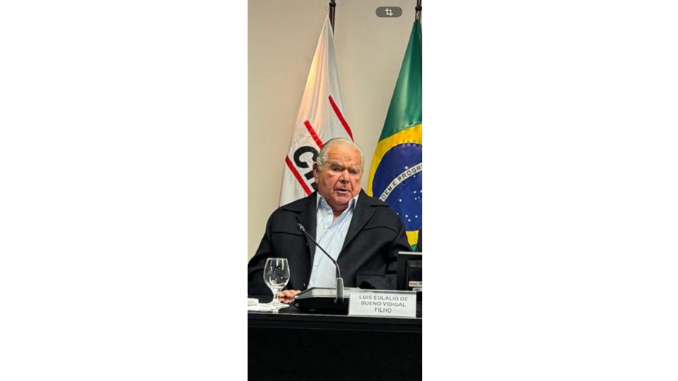
Businessman Luis Eulalio de Bueno Vidigal Filho passed away on the afternoon of June 29 in São Paulo at age 87 due to complications from intestinal ischemia and kidney failure.
Luis Eulalio presided over Cobrasma between 1980 and 1993 and the Federation of Industries of the State of São Paulo (Fiesp) from 1981 to 1986. The headquarters building of the entity, located on Avenida Paulista, bears his name. He was also a director and first vice president of the National Confederation of Industry (CNI) and is recognized as one of the main representatives of the renewal process of representative entities of the Brazilian productive sector that occurred in the 1980s, a period that preceded democratization.
Leading a movement of opposition formed by young São Paulo entrepreneurs, he ran for the presidency of Fiesp in 1980 against Theobaldo De Nigris, who was serving his eighth consecutive term, and won the election. During his administration, between 1981 and 1986, he became one of the country’s leading business leaders, using his institutional role to defend public policies aimed at industry and economic development.
In a context marked by the strengthening of worker union action, he argued that industrial entrepreneurs needed to reorganize to participate in negotiation processes, seeking to reduce tensions and promote the evolution of relations between workers and employers.
Throughout his career, he lived through periods of high inflation, growing public debt, and strong state presence in the economy. He maintained constant dialogue with authorities to discuss matters related to industry, economy, and national development. He advocated for the implementation of a project aimed at strengthening industrial activity, based on medium and long-term strategies, modernization of the industrial base, increased investments in technology, and reduction of government intervention in the economy.
His work at Fiesp also led him to undertake various trips abroad to present to international productive sector representatives the situation of the Brazilian economy and seek references for the modernization of national industry.
Described as a dynamic, proactive leader committed to results, Luis Eulalio also served on the National Monetary Council and maintained relationships with presidents of the Republic, ministers, and business leaders, frequently participating in discussions in Brasília.
A staunch parliamentarian, he never entered partisan politics. He advocated that business participation in politics should occur through their representative entities, contributing to the country’s economic development processes.
During his time as president of Fiesp, he balanced his activities at Cobrasma during the mornings with his routine at the business entity during afternoons and evenings, seeking to balance his professional, institutional, and family responsibilities.
Months before his death, in a statement about his trajectory as a business leader, he stated:
“I had the opportunity to experience important episodes, in times of enormous difficulties for companies and for industry as a whole, which demanded patience and courage from me. And, taking a critical look at the past, I must say that I learned from both mistakes and successes.”
On the same occasion, he declared:
“I am grateful to life for giving me so many opportunities to contribute in some way to Brazilian industry and to the development of my country. I am also grateful for having lived and worked alongside so many people who, like me, made efforts to do their best for the benefit of Brazil.”
Born in São Paulo on March 26, 1939, Luis Eulalio had northeastern and Paulista origins. He was the son of businessman and professor Luis Eulalio Bueno Vidigal, a pioneer in the capital goods industry, director and professor emeritus of the Law School of Largo de São Francisco.
He studied at Colégio São Luís and earned a degree in Law from the University of São Paulo (USP) in 1963. In 1965, he completed a postgraduate degree in Business Administration at the University of Illinois in the United States.
In addition to the presidency of Fiesp and positions held at CNI, he presided over the National Syndicate of the Automotive Components Industry (Sindipeças) and was first vice president of the Forging Industry Syndicate of the State of São Paulo. In 2008, he received the title of Emeritus President of Fiesp.
Luis Eulalio is survived by his wife, Lygia Fonseca Vidigal, his children Luis Eulalio Neto, Silvia Vidigal Ramos and Luis Fernando Vidigal, and ten grandchildren.
Be the first to comment