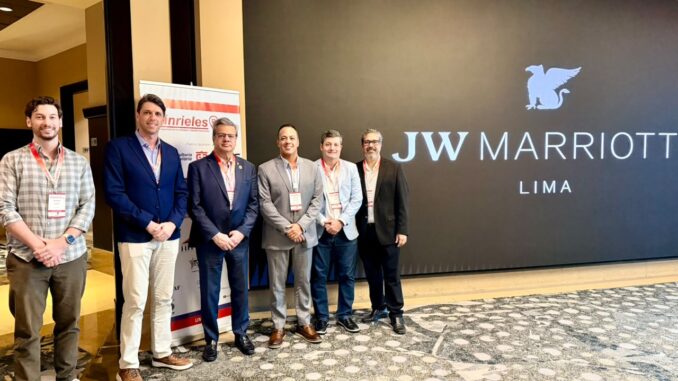
The first edition of the Latinrieles Peru Railway Activity and Industry Congress and Exhibition was held on June 1 and 2 at the JW Marriott Lima Hotel in the Peruvian capital. The event brought together more than 130 professionals in person, while approximately 1,600 people followed the live broadcasts on YouTube.
The positive reception of the inaugural edition led to the confirmation of a second event, scheduled for June 7, 8, and 9, 2027, also in Lima.
During the presentations, speakers emphasized the integration of the public and private sectors as a key factor in making the railway projects planned for Peru and Latin America viable.
Edgar Patiño cited the Lima–Barranca railway project as an example. The line will serve as a coastal corridor connecting the two cities while passing through the ports of Chancay and Callao. The project will extend for 245 kilometers, directly benefit approximately 4.5 million people, and involve investments of nearly US$4.4 billion.
Another speaker, Linda Bi of CRRC Dalian, addressed topics related to sustainability, smart technologies, and the energy transition in rail transportation.
Luis Loayza, representing Peru Sobre Rieles, highlighted the importance of railway human capital as a strategic asset for the future of the sector in Latin America.
On the second day of the event, Carmen Deulofeu, representing Lima Metro Line 2, presented details of the project currently under construction and emphasized the importance of public transportation in densely populated cities.
During her presentation, Deulofeu explained the concession and operating model of Line 2, presenting it as an example of cooperation between the public and private sectors. According to her, while the private sector seeks financing through the banking system, the government relies on multilateral organizations. The model provides for the infrastructure to be managed for 35 years while ownership of the assets remains with the state.
The executive also detailed aspects of station construction and line infrastructure. She stated that major cities have solved their traffic problems through two continuously applied measures: the construction of underground metro networks and the regulation of vehicle use in the most congested urban centers.
Ricardo Escalante of Cofeperu presented progress on the modernization of the Huancayo–Huancavelica railway. The project involves specific challenges due to its route through mountainous terrain and also adopts a public-private partnership model.
The modernization will cover the railway’s entire 128-kilometer length and includes the acquisition of new rolling stock, installation of track capable of supporting up to 20 tons per axle, replacement of 15 bridges, improvements to seven stations and 20 stops, and other railway infrastructure upgrades.
Manuel Wu, CEO of Lima Metro Line 1, presented projects aimed at increasing the line’s operational capacity. According to him, the logistical challenge is considerable because the work must be carried out without interrupting service, as no other lines are capable of fully absorbing passenger demand.
Wu explained that the project had been awaiting renewal of the operating authorization for Line 1 by the Peruvian government. During the event, he advocated for the document to be signed as quickly as possible. Two days after the conclusion of Latinrieles Peru, the executive confirmed on his social media channels that the renewal had been formalized, allowing a broad modernization process for the line to move forward.
Brazilian Participation
Brazil was represented by a delegation of business executives interested in expanding their presence in the Latin American railway market.
The delegation included Christian Peters of Rail Service; Claudinei Carvalho, Director of Revista Ferroviária; Igor Antonelli of Loram South America; Luís Melo of Progress Rail; Rodrigo Vilaça of Brasil on Rails; and Yugo Nomura of Frauscher/Wabtec.
Institutional Support
The event received institutional support from major Peruvian organizations, including the Urban Transport Authority for Lima and Callao (ATU), ProInversión, and the Ministry of Transport and Communications of Peru.
The organizers also highlighted the collaboration of Peru Sobre Rieles in the development of the congress’s first edition.
The closing panel featured José N. Villafañe, Secretary-General of the Latin American Railway Association (ALAF), who discussed the importance of railway integration across Latin America.
Revista Ferroviária served as a media partner for the event, reinforcing its commitment to disseminating strategic information and supporting the development of the railway sector through journalistic coverage of the main discussions and initiatives presented.
The next edition of the Latinrieles Peru Railway Activity and Industry Congress and Exhibition has been confirmed for June 7, 8, and 9, 2027, in Lima.
Be the first to comment